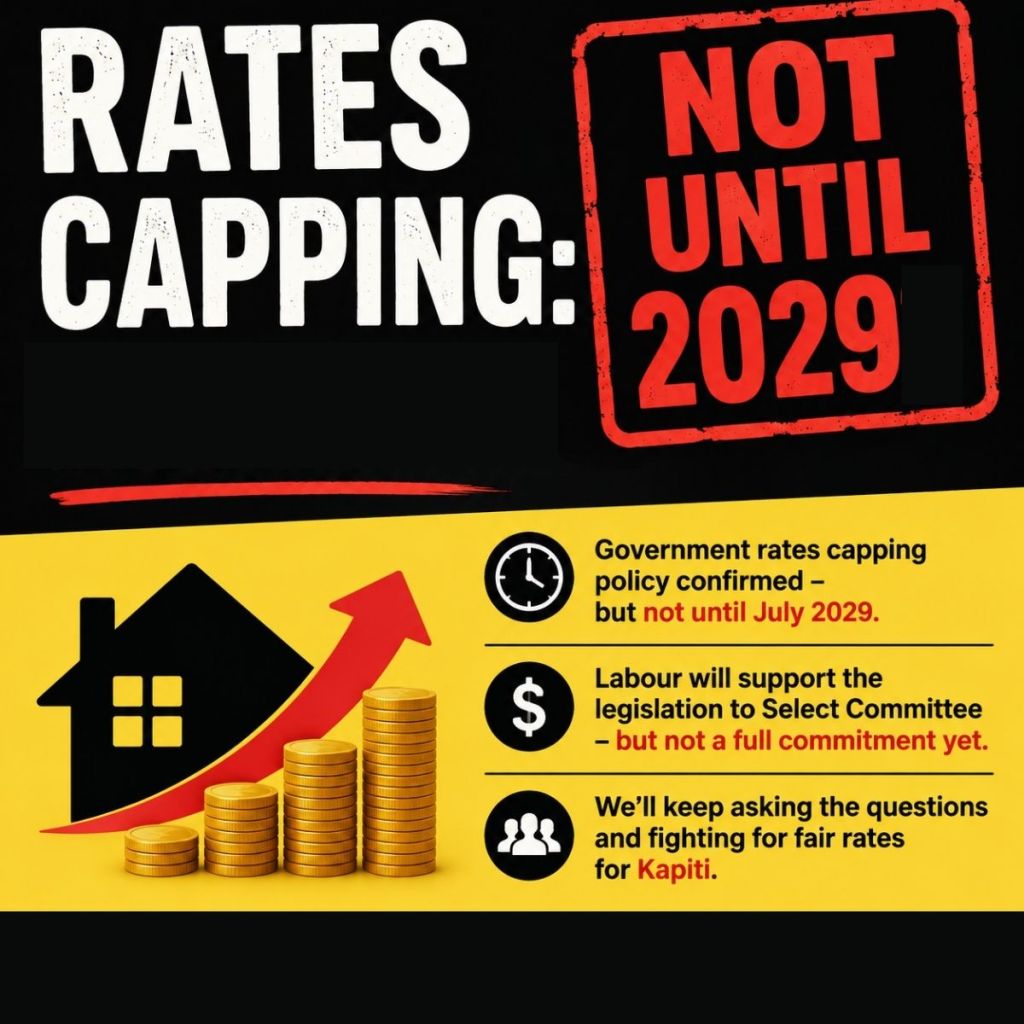
Local Government Minister Simon Watts confirmed that the Government will proceed with its rates capping policy if re-elected in this year’s election. He is on record as saying that the average amount households would save is only $34 a year. We know that this is not an accurate figure for the vast majority of households in Kapiti that have been facing average rates rises of over 43% since 2023.
The key features of the policy are unchanged from what had been foreshadowed earlier this year. Legislation will be introduced to Parliament before the election (but won’t be passed) to give effect to the policy that includes:
- Annual rates increases will remain within an initial target range of 2 to 4 percent.
- The target range will be reviewed every six years and updated where necessary to reflect costs outside councils’ control.
- Two types of time-bound exemptions will be available:
- Exceptional circumstances: where additional rates revenue is needed to recover from events such as natural disasters that go beyond what a council can reasonably be expected to plan for.
- Prudent financial management exemption: where a council can demonstrate prudent financial management and a justified need to operate above or below the target range. Councils will be required to consult their communities before setting rates.
- Water services are excluded from the rates capping system and will continue to be regulated separately.
- User charges are also excluded.
- Establishing an independent regulator responsible for monitoring compliance with the rates capping system and assessing exemption applications.
At a public meeting last week, Kapiti residents asked Prime Minister Christopher Luxon why the policy was not coming in sooner – 2029 is a long way away and residents can still face massive increases before then. The Prime Minister said that he would pass on the message to Simon Watts that residents wanted this to happen faster but there was no actual commitment to doing so.
For his part Simon Watts has said that the reason for the slow pace was the complexity of the legislation. When we have asked him, local MP Tim Costley has said the same thing. But some of us have been involved in complex legislation and we know it can be done much faster if there is a will to do so.
For their part, Labour have said that they will support the legislation in its first reading in Parliament. Labour’s local government spokesperson Tangi Utikere said the party was open to the rates cap in principle, and would support the legislation going to a Select Committee so that it could “hear from the public and local government, and learn more about the legislation and its impacts, and make changes so that the bill works better”. This does not mean that Labour will support the legislation all of the way through Parliament – it could still decide not to support the legislation after the Select Committee process. But it’s a stronger statement of support than Utikere made at a recent candidate meeting in Kapiti.
DISCLAIMER: CRK is not aligned to any political party. Our focus is on how Central Government decisions affect local government — and ultimately, the rates we all pay. We’ll continue asking the questions and reporting back on what the political parties are actually proposing.




Leave a Reply