
In an announcement that was predictable, the Government has confirmed that it will postpone its self-set deadline of September 30th 2026 to give initial approval of valid Head Start amalgamation proposals.
After imposing a narrow three-month process on Councils to come up with proposals aimed at restructuring local councils into unitary authorities with amalgamation of two or more councils, Local Government Minister Simon Watts and Minister Chris Bishop have confirmed that Cabinet will no longer decide this month which of the 18 Head Start proposals received should progress further. Instead, those decisions will be postponed until early 2027.
This was predictable, given how close we are to the general election, how much time is required to consider amalgamation proposals properly, and the complexity of local government reform.
When the Government launched Head Start in May, councils were given just three months to develop proposals for the most significant restructuring of local government since 1989. All things considered, delaying those decisions is the right call. But it leaves communities to wonder whether what the Government was really doing was just taking ‘soundings’ on the public and local authority reaction. And perhaps testing what proposals might shake out of the tight timetable that might either be viable, or would shine further light on the concept of amalgamated unitary authorities and the practical implications of such a re-organisation.
For councils that were ready to go on their amalgamation proposal (and had an agreement from everyone to proceed), it is surprising that the Government didn’t decide to give the go-ahead for them to get on with it. That would have signaled to everyone else its intention to take action, and allow future mergers to benefit from the experience of the front-runners. However, we have no idea about the nature of the proposals that were submitted, or the viability of cases presented.
Councils around the country may be hopping mad about having been put through this three-month process, only for decisions to now be delayed. Would councils have done the work on it if they had had more time? No doubt some will be annoyed at having had to ‘waste time’ on developing their proposals at all and will complain about it being a waste of effort and money. Some may consider that rushing councils into the three-month process, diverting time and resources into doing so, and then for nothing to happen at all at this stage, is a poor outcome.
However, obliging councils to consider amalgamation options isn’t necessarily a bad thing. Over the last few years, many councils have been consistently dishing out high rates increases and engaging in enthusiastic spending on ‘non-essentials’ to the point where communities are struggling with affordability. The response from councils and Local Government New Zealand to Government directives to re-focus on core services has been surly at best. The three-month process to come up with amalgamation proposals may have been intended not only to shake out viable options but to shake up the thinking in local councils.
On the other side of the political fence, opposition parties have avoided openly committing to not retaining amalgamation as a potential policy option. It might be noted that Labour when in government was proceeding with ‘Three Waters’, which was a co-governance model based on amalgamated water entities. So consideration of amalgamation options is likely to be on the table regardless of which government is in power in 2027.
When it comes to politics, there isn’t always much to recommend ‘looking on the bright side’, but perhaps the decision announced today represents an example.
Our own Kapiti Coast District Council had a ‘Plan B’ option to consider amalgamation with Horowhenua District Council. Having done the initial groundwork, the extra time between now and early next year gives Council more time to develop a cost-benefit analysis for both its stand-alone option and an amalgamation with Horowhenua. And more time to consider the implications of becoming a unitary council. Perhaps we should be thankful for Kapiti that the extra time will allow for comprehensive further examination of a Horowhenua option, which is a good development.
From a range of perspectives, pressing pause on a speedy march towards amalgamation at this point is good news, even if one adopts a cynical view about the Government’s motivation being the election timetable, or takes a view about bad process. Postponement gives everybody a chance to consider sensible options and the scale of implementation.
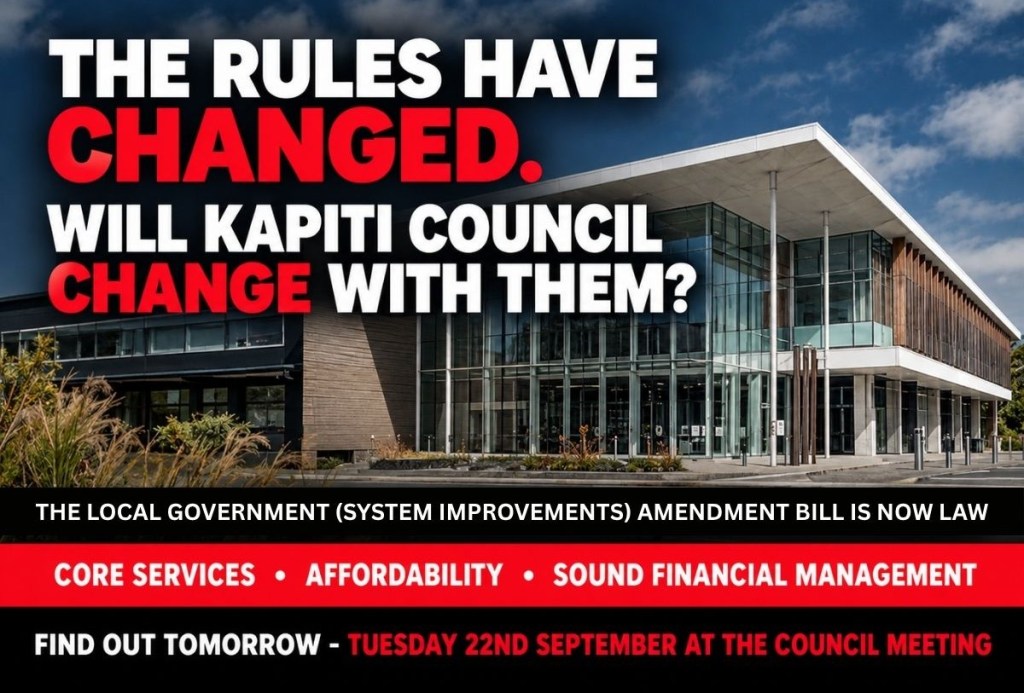
The current Government passed the Local Government Systems Improvement Act, which repeals the ‘wellbeing’ clauses, before the House rose for the election campaign, together with the two Bills that make up the RMA reform. With these significant changes now passed into law, both central and local government and the communities they represent need time to consider the direction of travel from 2027 onwards.



Leave a comment