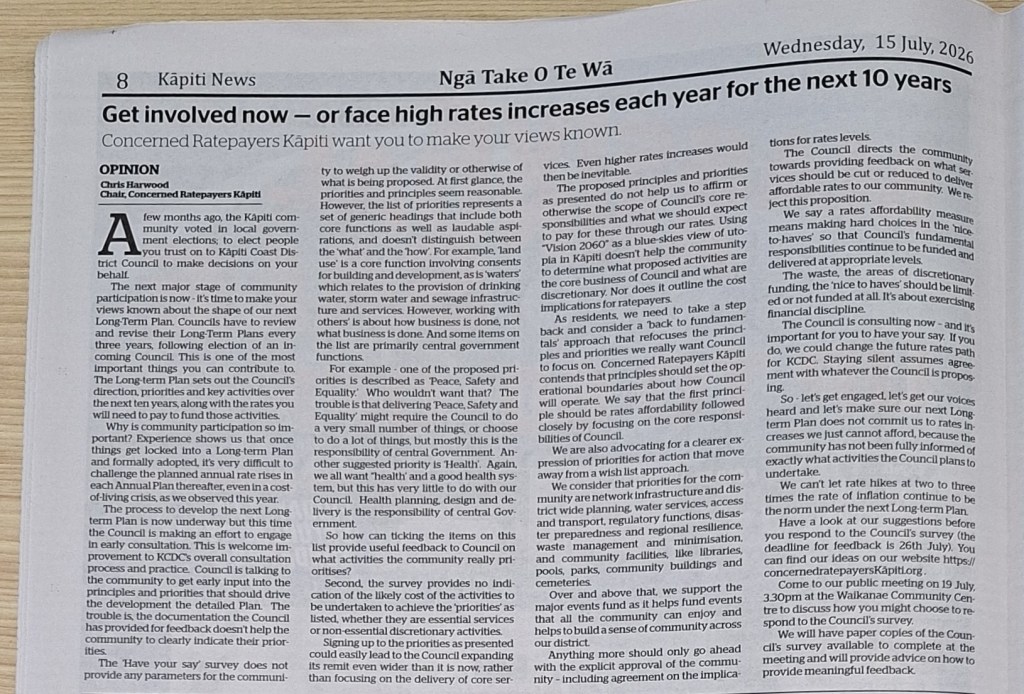
Opinion Piece – Kapiti News, 15 July 2026
By Chris Harwood, Chair, Concerned Ratepayers Kapiti
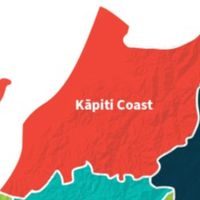
A few months ago, the Kapiti community voted in local government elections; to elect people you trust on to Kapiti Coast District Council to make decisions on your behalf.
The next major stage of community participation is now – it’s time to make your views known about the shape of our next Long-Term Plan. Councils have to review and revise their Long-Term Plans every three years, following election of an incoming Council. This is one of the most important things you can contribute to. The Long-term Plan sets out the Council’s direction, priorities and key activities over the next ten years, along with the rates you will need to pay to fund those activities.
Why is community participation so important? Experience shows us that once things get locked into a Long-term Plan and formally adopted, it’s very difficult to challenge the planned annual rate rises in each Annual Plan thereafter, even in a cost-of-living crisis, as we observed this year.
The process to develop the next Long-term Plan is now underway but this time the Council is making an effort to engage in early consultation. This is welcome improvement to KCDC’s overall consultation process and practice. Council is talking to the community to get early input into the principles and priorities that should drive the development the detailed Plan. The trouble is, the documentation the Council has provided for feedback doesn’t help the community to clearly indicate their priorities.
The ‘Have your say’ survey does not provide any parameters for the community to weigh up the validity or otherwise of what is being proposed. At first glance, the priorities and principles seem reasonable. However, the list of priorities represents a set of generic headings that include both core functions as well as laudable aspirations, and doesn’t distinguish between the ‘what’ and the ‘how’. For example, ‘land use’ is a core function involving consents for building and development, as is ‘waters’ which relates to the provision of drinking water, storm water and sewage infrastructure and services. However, working with others’ is about how business is done, not what business is done. And some items on the list are primarily central government functions.
For example – one of the proposed priorities is described as ‘Peace, Safety and Equality.’ Who wouldn’t want that? The trouble is that delivering ‘Peace, Safety and Equality’ might require the Council to do a very small number of things, or choose to do a lot of things, but mostly this is the responsibility of central Government. Another suggested priority is ‘Health’. Again, we all want “health’ and a good health system, but this has very little to do with our Council. Health planning, design and delivery is the responsibility of central Government.
So how can ticking the items on this list provide useful feedback to Council on what activities the community really prioritises?
Second, the survey provides no indication of the likely cost of the activities to be undertaken to achieve the ‘priorities’ as listed, whether they are essential services or non-essential discretionary activities.
Signing up to the priorities as presented could easily lead to the Council expanding its remit even wider than it is now, rather than focusing on the delivery of core services. Even higher rates increases would then be inevitable.
The proposed principles and priorities as presented do not help us to affirm or otherwise the scope of Council’s core responsibilities and what we should expect to pay for these through our rates. Using “Vision 2060” as a blue-skies view of utopia in Kapiti doesn’t help the community to determine what proposed activities are the core business of Council and what are discretionary. Nor does it outline the cost implications for ratepayers.
As residents, we need to take a step back and consider a ‘back to fundamentals’ approach that refocuses the principles and priorities we really want Council to focus on. Concerned Ratepayers Kāpiti contends that principles should set the operational boundaries about how Council will operate. We say that the first principle should be rates affordability followed closely by focusing on the core responsibilities of Council.
We are also advocating for a clearer expression of priorities for action that move away from a wish list approach. We consider that priorities for the community are network infrastructure and district wide planning, water services, access and transport, regulatory functions, disaster preparedness and regional resilience, waste management and minimisation, and community facilities, like libraries, pools, parks, community buildings and cemeteries. Over and above that, we support the major events fund as it helps fund events that all the community can enjoy and helps to build a sense of community across our district. Anything more should only go ahead with the explicit approval of the community – including agreement on the implications for rates levels.
The Council directs the community towards providing feedback on what services should be cut or reduced to deliver affordable rates to our community. We reject this proposition. We say a rates affordability measure means making hard choices in the ‘nice-to-haves’ so that Council’s fundamental responsibilities continue to be funded and delivered at appropriate levels. The waste, the areas of discretionary funding, the ‘nice to haves’ should be limited or not funded at all. It’s about exercising financial discipline.
The Council is consulting now – and it’s important for you to have your say. If you do, we could change the future rates path for KCDC. Staying silent assumes agreement with whatever the Council is proposing.
So – let’s get engaged, let’s get our voices heard and let’s make sure our next Long-term Plan does not commit us to rates increases we just cannot afford, because the community has not been fully informed of exactly what activities the Council plans to undertake. We can’t let rate hikes at two to three times the rate of inflation continue to be the norm under the next Long-term Plan.
Have a look at our suggestions before you respond to the Council’s survey (the deadline for feedback is 26th July). You can find our ideas on our website https://concernedratepayerskapiti.org .
Come to our public meeting on 19 July, 3.30pm at the Waikanae Community Centre to discuss how you might choose to respond to the Council’s survey. We will have paper copies of the Council’s survey available to complete at the meeting and will provide advice on how to provide meaningful feedback.




Leave a Reply