Answer: NO. But that’s what KCDC has been telling us over the past few years.
Tell KCDC the level of this year’s planned 6.5% rates increase is not OK at their “feedback session” on the planned rates increase on 26 May – (details at the end of this message)
One of KCDC’s favourite reasons why your rates have gone up by 35% since the current Council leadership was elected, while general inflation has only been 11.2%, is that local government costs go up faster than general household costs. It’s apparently a “fact” that has been constantly repeated by the Mayor and Councillors. We’ve heard it confidently stated by some of the newly elected Councillors, clearly being well-inducted into the Council’s rhetoric.
It’s a key part of the story that KCDC has used over the past few years to justify high rate levels. The story goes: “we’d love to have lower rates increases than we’ve got, but local government costs increase at a faster rate than general inflation, so there is nothing we can do”. In KCDC’s story, the Council is a hapless victim of economic forces outside of its control, and you’ll just have to live with the resulting rates increases.
In the past we’ve tried several times to point out to Councillors that this story is simply untrue, but they’ve been having none of it. Our analysis has been written off because, it seems, we use the wrong figures and we can’t do maths.
But a recent report from Infometrics makes it clear that the Council’s story isn’t true.
It’s a report to Wellington City Council entitled “Wellington City Rates Affordability Research”. It includes an analysis of how local government operating costs (rates pay for operating costs) compared to general inflation (the Consumers’ Price Index or CPI).
There was a time that local government operating costs (measured by the “Local Government Cost Index”, or the “LGCI”) were above CPI. But that stopped in 2021. Since the time the current Council leadership was elected, the LGCI and the CPI have tracked each other very closely. It’s shown in the graph from the report, shown below:
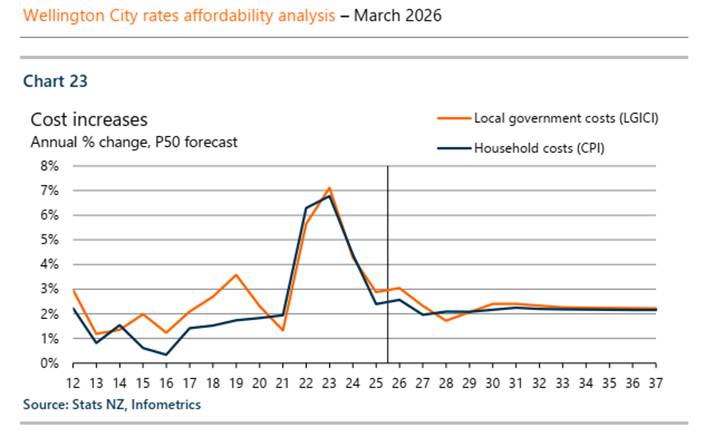
Infometric’s analysis shows that sometimes the CPI is slightly above the LGCI, and sometimes it’s slightly below. What’s remarkable is how closely they have tracked each other since 2021 – and how closely they are forecast to track each other for the next 10 years. What is very clear is that local government operating costs have not risen three times faster than the rate of general inflation.
So one of the key justifications that the Council has used for on-going high rates increases in Kapiti has just been blown out of the water by an agency (Infometrics) that the Council relies heavily upon for much of its economic analysis work. And it seems that, at Concerned Ratepayers Kapiti, we do use the right figures and we can do maths after all.
So, why are your rates going up by so much then?
We know that some Councillors want to deliver lower rates increases for you. But, to date, not enough of them are really working to achieve that. So far, too many Councillors have been comfortable with high rates increases – if they weren’t, they wouldn’t keep voting for them. Some Councillors want to spend your money on securing their personal legacy by pushing through their pet projects. So far, not enough Councillors are challenging the cost-plus budgeting model that the Council staff like to use, and not enough Councillors are challenging how your money is being spent. Too many Councillors have bought into the story that high rates increases are inevitable, and that there is nothing that they can do.
In last year’s election, over half of the previous Council were tossed out. We don’t think that this happened because we wanted the new Council to carry on down the rates path that the old Council set out. But with an indicative rates increase of 6.5% (according to the Council’s website) from 1 July, that seems to be what is happening. More of the same.
We can be somewhat charitable to new Councillors as they have just stepped into a big job – and we suspect a much bigger job than many of them anticipated. But we think the Councillors that were re-elected could have steered the Council to a lower rates path this year – if they wanted to.
The Council is holding a feedback session on the proposed rates increase on 26 May – but unfortunately this will not affect this year’s decision as the rates increase for 2026/27 is essentially a done deal. No matter what you say on 26 May, your rates will go up by approximately 6.5% as the Council is signalling.
So the attention needs to start moving towards the new Long Term Plan that will be developed later this year. This new Long Term Plan matters, as it will set the rates path for the next 10 years. And we have seen that once the Long Term Plan is set, this Council stops talking to the community about annual rates increases. So the new Long Term Plan really matters.
For this new Long Term Plan, we think the “honeymoon period” for Councillors – both new and old – is over. Now that it has been shown by the Council’s own economics advisor that local government operating costs do not inevitably increase faster than general inflation, will Councillors keep on agreeing to high rates increases in the upcoming Long Term Plan? Will they keep on supporting a cost-plus budgeting system, and high spending on non-core, pet projects? Or will they stand up and say: “Enough is enough”?
We are calling upon Councillors – both new and old – to do what they were elected to do, to stop the cost-plus approach and to get rates increases back to no more than the general rate of inflation. Because – if nothing else – Infometrics has shown us that that is how much KCDC’s costs are expected to go up by.
YOU CAN HELP
- Contact your local Councillor and tell them in clear terms what is your expectation for future rates increases. Tell them that they will be monitoring how they vote.
- Go to the “feedback session” hosted by KCDC on 26 May – and tell Councillors in person. Tell them that you don’t accept the 6.5% planned rates increase, and about the lack of meaningful public engagement about it.
Because if you don’t, Councillors will come to the view that you are happy with what’s going on, and will carry on as they have been.
We will carry on the fight, and will let you know whether your Councillor is doing what you expect of them. But our voice is stronger if you are actively part of it too.
Details of the Council’s “feedback session” on the 2026/27 Annual plan – and the indicative rates increase of 6.5% – is as follows (taken from the KCDC website):
“We’re holding two public sessions to provide an opportunity for you to talk directly to elected members about the decisions we’ve made when forming this Annual Plan.”
Tuesday 26 May
10–12 noon and 5–6pm
In the foyer of the Council building on Rimu Road, Paraparaumu.
You can also share your views at any time by emailing annualplan@kapiticoast.govt.nz.”