A three-part analysis of the budget system driving Kāpiti’s rates increases
On 5th February 2026, members of Concerned Ratepayers Kapiti attended the Council’s briefing #3 on next year’s Annual Plan. (The public were excluded from Council briefings #1 and #2, where initial decisions were made behind closed doors). Although this sounds like a very dry topic, it’s actually the process by which KCDC sets its budget for the coming year, which in turn determines what the rates are going to be for next year. At the moment, it looks like next year’s rates increase will be between 5.7% and 6.4%, even though general inflation is just over 3%.
What we saw was that the way KCDC sets its budgets is the primary reason for why your rates have risen astronomically in the last 4 years – by 43% on average since June 2022. There were several Councillors who were trying to stem the tide, but the way KCDC currently sets its budgets pretty much stops them in their tracks.
The key is in this Council diagram below:
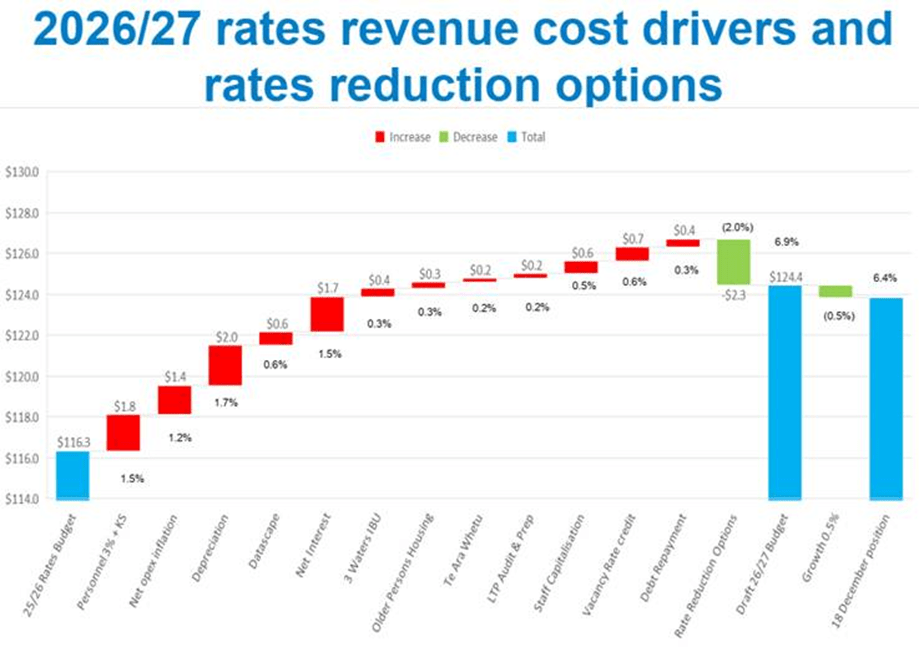
This diagram shows how the Budget for next financial year – 2026/27 – is constructed.
It starts off on the blue bar on the left-hand side of the diagram, which is the Council’s budget for this current financial year (2025/26) – $116.3 million.
In the diagram, the starting budget is then increased by a succession of red bars – so-called “cost pressures” – that are simply added onto the starting budget. These “cost pressures” are things like increases in salaries and “inflation,” as well as some very specific items. These bits in red are simply added onto the opening budget of $116.3 million. They are taken as a given. At Council briefing #3, there was no discussion about whether these were reasonable, or should be treated in some other way. They are simply just added onto the bill.
This is cost-plus pricing in action. And you, the ratepayer, are paying for it.
Some of these “cost pressures” seem high to us. One that stood out was “personnel costs” which are slated to increase by $1.8 million. That’s on top of a budgeted personnel cost of $39.7 million this financial year (Source: OIR 2425/1353, question 4) – or in other words a 4.5% increase. That’s much faster than the 2% growth in wages and salaries across New Zealand in 2025. Somehow, KCDC’s system of cost control results in staff salaries increasing at more than twice the rate of the economy as a whole.
Because of all of these “cost pressures,” the budget for 2026/27 jumps to just over $126 million. Suddenly the Councillors are facing an 8.4% rates hike if they do nothing. Even for Councillors who are comfortable with imposing high rates – yes, there are some – this is too much. So they have to scramble around to see whatever they can find as “savings.”
Anticipating this problem, Council staff put together a random list of expenditure cuts that they describe as “low hanging fruit.” There is no logic or principle behind these savings options other than staff regard them as “low hanging’ – which usually means easy to identify. Importantly, all the identified ‘savings’ are cuts to grants and subsidies to business groups, community groups, and non-Council entities. None of the savings are within Council staffed functions, except for a couple of items that are coming to the end of their natural life anyway.
Wanting to avoid a rates increase of 8.4%, Councillors are left debating the list of “low hanging fruit.” What they are scrambling over are options that involve terminating or reducing payments to business and community groups by small amounts – $40,000 here, and maybe $50,000 there. But what is not being discussed at all are the underlying drivers of why the budget has blown out in the first place.
To their credit, at Briefing #3, some Councillors did try to ask about the value and efficiency of the core Council budget (the starting $116.3 million), and whether there are savings to be had there. But they are quickly and firmly batted away and directed back to the list of “low hanging fruit.”
At the time of writing, Councillors haven’t made final decisions on all of the list of “low hanging fruit.” Depending on what they decide, the rates increase next year will be between 5.7% and 6.4%.
Don’t get us wrong – we agree that most of the “low hanging fruit” should indeed be picked. But this cost-plus way to set the budget is completely the wrong way around. Based on our professional experience, if we were going to design a budgeting process that maximises Council spending, completely protects the budgets of Council staff, and limits the ability of Councillors to ask questions about the value and efficiency of Council spending, we would design the system KCDC has.
In out next article, which we will send to you tomorrow, we will explore what some of the defenders of KCDC’s process might say, and why those arguments are weak. And in our third article, we will set out how this system can be changed so that rates increases can be lower and Councillors can have much more of a say in how the budget is set. In the meantime, please send or give this article to any of your friends, neighbours or family who are concerned about how they are going to pay their rates. Because they deserve to know what’s going on … because they are the ones footing the bill!

 Concerned Ratepayers Kapiti