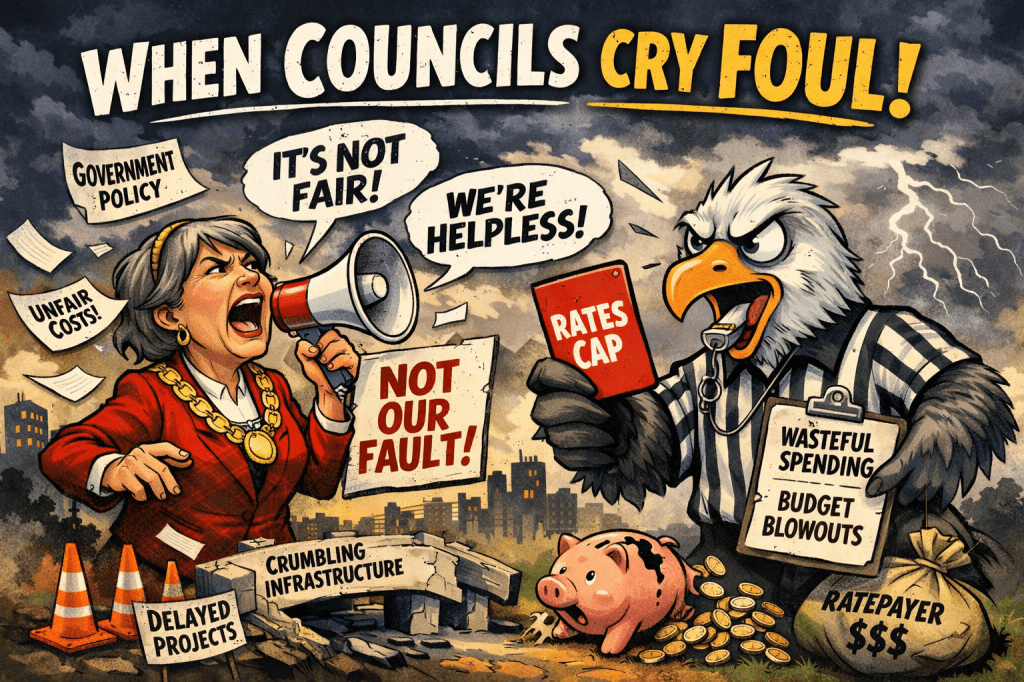
Kapiti’s mayor, Janet Holborow, wrote an article in The Post over the long weekend complaining about one of the current Government’s most popular policies, rates capping. Her basic argument – see https://www.thepost.co.nz/politics/360932799/rates-capping-wont-fix-whats-really-driving-costs – is that Councils are the hapless victims of cost pressures outside of their control, burdened by changes in Government policy and “ a stream of extra expectations and legislative change from central government”. Implicit in her argument is that Councils up and down New Zealand – including Kapiti – are 100% efficient, costs are tightly managed, and there’s not a single dollar of questionable spending anywhere. It’s all someone else’s fault, and Councils are powerless in the face of forces outside of their control.
These are, of course, the standard speaking points of Local Government New Zealand, the trade union for local authorities.
The other playbook from Local Government New Zealand is to scare you into believing that rates capping will inevitably lead to cuts in infrastructure building and maintenance, leading to infrastructure deficits. This argument also assumes that Councils are 100% efficient but also tries to trick you into thinking that the only thing that Councils do is spend money on infrastructure.
If only these claims were true.
You will hear these claims from many (but not all) Mayors up and down the country, but we can only speak for Kapiti, so let’s assess these claims against what’s going on here. As much as some Councillors don’t like us using these figures – because of the picture they paint – they are all from KCDC’s Annual Reports, from Official Information Requests or from papers to the Council itself:
- Rates revenue has increased from $75.7 million in 2021/22 to $106.4 million in 2024/25 – a 41% increase in three years.
- Operational staffing costs rising from $30.1 million in 2021/22 (revised figures included in Note 6 to the 2022/23 Annual Report) to $42.8 million in 2024/25 – a 42% increase in three years. Much of this increase is due to paying existing staff more.
- Spending on grants and sponsorships increasing from $0.819 million in 2021/22 to $3.1 million in 2024/25 – a whopping 275% increase in three years.
- Spending about $3 million each and every year on “economic development” activities, funded predominately by residential rates.
- Systemic overspending on “operating expenses” (excluding interest and depreciation) Last year’s budget for operating expenses was $82.884 million, which the Council overspent by $6.433 million – or 7.8%. This year, KCDC is on track to overspend its operating expenses budget of about $85 million (excluding a one-off cost, that will now not occur this year) by about $4.8 million. Not one question was asked about this year’s looming overspend at December’s Council meeting, even though we pointed it out to Councillors at the time.
These spending increases have all been enabled by KCDC adopting the “Economic Doughnut” model to guide its Long-Term Plan. Although well-intentioned, the “Economic Doughnut” model tries to be all things to all people. Everything is inter-connected and important. Nothing is off the table. No wonder spending – and rates – have increased at such an incredible rate in Kapiti. As anyone who has managed a budget will know, if everything is a priority then it’s impossible to prioritise to the things that really matter, and that you and only you can do.
Massive rates increases up and down New Zealand haven’t happened because of what central government has done. Our Council hasn’t increased rates revenue as much as it has because it suddenly had $30 million of extra costs dumped onto it by central Government. This has happened because of the spending choices the Council has chosen to make in the past three years, and because it lacks the discipline to impose, and stick to, any kind of reasonable budget limit.
To be fair to the Mayor, there are some operational costs that are hard for the Kapiti Council to manage. The Mayor mentions some – operating cost inflation, interest, and depreciation costs – although we note that interest rates have dropped since the Council last did its 10-year budget. Insurance costs are also hard to manage in the current environment. But the prevailing attitude is to simply add these to your rates bill. It’s not to think about “if these costs are going up, what else can we trim back on so that we minimise the impact on ratepayers”? Central government departments have been told – for example – that they must find ways to be more efficient and absorb any extra operating costs they face. This means that government departments have an incentive to keep costs rises to a minimum, and to work their budgets harder. You have to do the same thing for your household, or for your business. But this incentive does not yet exist in KCDC.
Getting rates increases back under control – to the limits set out in the Government’s rates cap – requires a wholesale change in how KCDC thinks about and manages its finances. More of the same financial management practices at KCDC will simply deliver higher and higher rates.
We support the Government’s rates cap because we won’t get any change without it. It seems to be the only way to get a reasonable budget constraint on Councils – as they have all shown they cannot do it themselves. The position of our Mayor, of Mayors up and down the country, and Local Government NZ, makes this abundantly clear. If it wasn’t for the looming rates cap, we would just get more of the same.
Our Mayor is right on one thing – winding this back will include some hard choices, and some people are going to be disappointed. That’s only because of a whole bunch of spending choices that have been made over the past three years. But making these choices is the job that the Mayor and Councillors are elected to do.
The good news is that Concerned Ratepayers Kapiti provided all incoming Councillors with a briefing pack of how to get future annual rates increases at or below 3% per annum [read it here]. Our options did not include cutting core Council services – pipes, parks, pools, libraries. It doesn’t require cutbacks in infrastructure. Instead, it was about restraining and, in some cases, rewinding, some of the other spending that has crept in over the past three years.
Almost all of the new Council were elected promising to reduce the level of future rates increases. Many of them talked about setting rates to about 5% of Kapiti median household incomes – a level that was used as the benchmark until 2023. If the Council went back to that, it would require rate increases of around 3% on average. This is within the range that the Government is now talking about for the rates cap.
The question is now: is this new Council up to it? Will the Council take note of the expectations of central Government to limit increases to between 2-4% in the coming year? Will the Council consider how to deliver quality core services within capped budgets, or will it continue to try to fund anything and everything? Will this Council engage with the community on the hard choices that now need to be made by presenting genuine options, or by shroud waving (which is what we see many other Councils do)? Or is the Mayor’s column just part of the process of softening us up for a continuation of rates increases of 7% per annum?

 Concerned Ratepayers Kapiti
Leave a comment