
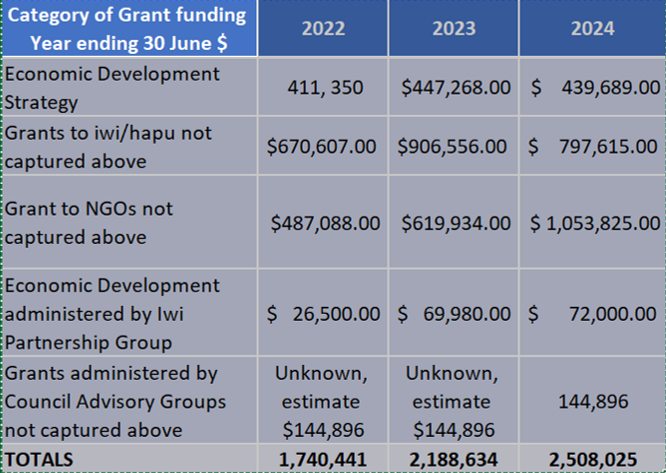
We’ve been asked about partnerships and their impact on ratepayers in Kāpiti. This is a difficult task and this is the closest we can get to an answer. You can see there is some approximation. You wont be surprised that spending in this area 44% over the last three years. Some of these disbursements are legal responsibilities. But, the amount spent is not mandated so all sums become in some ways discretionary.
Lets look at the big ticket items.
Economic Development Strategy
KCDC plans to spend $31 million over 10 years on its Economic Development Strategy, funding business clusters, events, start-ups, and Māori economic development. The governance structure itself within this group is eye watering. What is becoming clearer is that the plan seems to be to use both the ratepayers and business contributions to fund the board and these initiatives. We will all become angel investors.
Discretionary Iwi Payments
KCDC is legally required to engage with iwi under the Local Government Act and Resource Management Act. To support this, annual capacity-building payments are made to iwi partners.
The Need for Clear Outcomes
Across its grants and partnerships, KCDC faces recurring issues:
Lack of outcome based KPIs with an over-reliance on vague metrics. Transparency isn’t one of those metrics from what we can see. An example of this is that Financial reporting often fails to link spending with tangible benefits for ratepayers.
What is the answer to this? Establish outcome-based KPIs for all grants and partnerships. Provide clearer reporting on how/why funds are allocated and then report back on actual performance. Lets see if the promises matched the outcome.
During an affordability crisis, ratepayers deserve accountability to ensure their money delivers real value.
Remember, when it comes to saving $, you only hear about cutting the things you care about. Lets find representatives who value affordability.



 Concerned Ratepayers Kapiti
Leave a comment